Cabinet hinge repair examples
See what changes when a discontinued hinge is replaced. These examples link the observed steps to the manufacturer’s drawing so you can compare them with your own cabinet.
Replacing a Blum COMPACT 33
Demonstrated by Blum
- Before
- The original COMPACT 33 has a separate mounting plate and a screw-on cup in Blum’s example.
- After
- The replacement cup uses the existing door-side holes in the example. A one-hole cabinet-side fixing can require a new pilot between the old holes.
Measure the overlay, then compare the frame entry points and door holes before choosing 38N or 39C.
Replacing a Blum COMPACT 31
Demonstrated by Blum
- Before
- The old cup fasteners sit in a different orientation from the new COMPACT hinge.
- After
- Blum rotates the cup and marks fresh door-side holes. The old screw holes remain visible.
Support the door, seat the cup, and check the frame fasteners before marking new holes. Use the separate 38B drawing for an applicable face-mount conversion.
Grass TEC 830 to TEC 864 retrofit
Documented by Grass America
Grass’s chart groups 830-13 and 830-20 at 1⅜″ overlay and lists 04548A-15 for soft-close or 04498-15 for self-close. In the fitting drawing, the replacement keeps the cup bore and matching frame holes. The door-side pilot holes move.
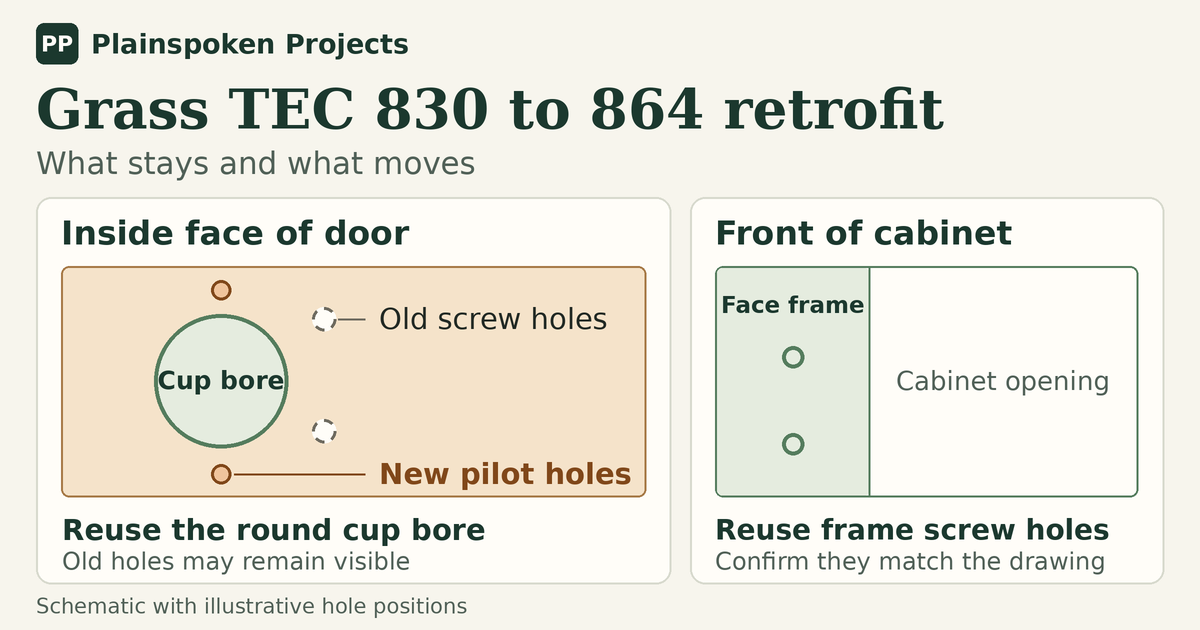
- Reuse the cup bore
- On the documented retrofit, the replacement cup fits the existing round bore.
- Reuse the frame screw holes
- Keep the cabinet-side fastener holes when they match the Grass retrofit drawing.
- Drill new door-side pilot holes
- The small screw holes beside the cup move on the TEC 864. The old holes may remain visible.
Share what happened on your door
Record the old stamp, overlay, SKU tried, and which holes lined up. Photos of the old mount and the finished repair help us review the result.
Send a fit report